Cryptocurrency is becoming part of everyday finance. Millions of people around the world use it to send money to family abroad, or simply have more control over their own money. Whether you want to make your first purchase, understand what your friends are talking about, or explore new ways to manage your finances—this guide will help you get started.
By the end of this guide, you will understand what cryptocurrency actually is in simple terms, know the difference between platforms where you buy crypto, understand how wallets work and how to keep your money safe, and be able to make your first cryptocurrency purchase confidently.
The Journey Ahead: We'll walk through this in a logical order. First, we'll cover the essential concepts—blockchain, networks, and cryptocurrencies. Then, we'll explain how the crypto ecosystem works: platforms where you buy crypto and wallets where you store it. Finally, we'll walk through making your first purchase on Binance (which conveniently provides both a platform and a wallet in one place) and how to send cryptocurrency. Each step builds on the last.
Disclaimer: This guide is for educational purposes only and does not constitute financial advice. Cryptocurrency investments carry significant risk, including the potential loss of your entire investment. Always do your own research, understand the risks involved, and never invest more than you can afford to lose.
What is Blockchain and Web3?

Before you can safely use cryptocurrency, you need to understand the technology behind it—not because you need to be an expert, but because this knowledge protects you from common mistakes that cost people real money. Every year, millions of dollars are lost because people send crypto to the wrong network or don't understand how blockchain addresses work. Let's start with the basics.
Blockchain is the technology that makes cryptocurrency possible. Think of it as a digital record book that is shared across thousands of computers worldwide. Every transaction is recorded and verified by the network, making it nearly impossible to cheat or fake transactions.
Web3 refers to the next generation of the internet built on blockchain technology. While Web2 (today's internet) relies on companies like Google and Facebook to store your data and control your accounts, Web3 gives you direct ownership of your digital assets and data. Anything fully on the blockchain is protected—no company can delete or freeze it. However, centralized services that use Web2 as an entry point (like exchanges) can still restrict your access, which is why understanding the difference matters.
What is Cryptocurrency?
At its core, cryptocurrency is digital money that uses cryptography for security and operates on blockchain technology. Each cryptocurrency exists on a specific network (like Bitcoin network, Ethereum network, or Solana network). Unlike traditional currencies issued by governments, most cryptocurrencies are digital-only (they exist as entries on a distributed ledger, not as physical coins or notes), secured by cryptography (mathematical algorithms protect transactions and control the creation of new units), and decentralized in most cases (no single institution controls the network).
Here's a quick overview of the most popular cryptocurrencies you'll encounter:
| Currency | Symbol | Network | Primary Use Case |
|---|---|---|---|
| Bitcoin | BTC | Bitcoin | Store of value, digital gold |
| Ethereum | ETH | Ethereum | Smart contracts, decentralized applications |
| Tether | USDT | Multiple (Ethereum, Tron, etc.) | Stablecoin pegged to USD |
| USD Coin | USDC | Multiple (Ethereum, Solana, etc.) | Regulated stablecoin |
| Solana | SOL | Solana | High-speed transactions, DeFi |
Bitcoin, launched in 2009, remains the largest cryptocurrency by market capitalization and is often viewed as "digital gold"—a store of value rather than a medium for everyday transactions. Ethereum, the second-largest, introduced smart contracts that enable programmable money and decentralized applications (dApps).
Now that you understand what cryptocurrency is, here's your first practical challenge: networks. This might seem technical, but understanding networks is what prevents the most common and costly mistake in crypto—permanently losing money by sending it to the wrong address or on the wrong network. Thousands of people have lost funds this way, and those transactions cannot be reversed.
Understanding Networks
Every cryptocurrency operates on a network—think of it as the highway system that crypto travels on. Just like you can't drive a car on train tracks, you can't send Bitcoin on the Ethereum network.
Why choosing the network matters: Some networks process transactions in seconds (Solana), others take minutes (Bitcoin). Transaction fees vary dramatically—from fractions of a cent to several dollars. Different networks also support different capabilities like smart contracts and NFTs.
Here are the common networks you'll encounter:
| Network | Supports | Speed | Typical Fees |
|---|---|---|---|
| Bitcoin Network | Only BTC | Minutes | $1-5 |
| Ethereum Network | ETH and ERC-20 tokens | Minutes | $2-50+ |
| Solana Network | SOL and SPL tokens | Seconds | < $0.01 |
| BNB Chain | BNB and BEP-20 tokens | Seconds | < $0.50 |
| Polygon | MATIC and tokens | Seconds | < $0.01 |
Note: Fees vary based on network congestion. Ethereum fees can spike significantly during high demand.
Platforms and Wallets: The Two Things You Need
Now you understand what cryptocurrency is and how networks work. But how do you actually use it? To send or receive crypto, you need two things:
- A Platform – Where you buy, sell, or trade cryptocurrency
- A Wallet – Where your cryptocurrency is stored
Think of it like online shopping: the platform is the store where you make purchases, and the wallet is your bank account where the money comes from (and goes to). The good news? Many platforms—like Binance—provide both in one place, making it easy to get started.
Cryptocurrency Platforms
Centralized Exchanges (CEX) are the most common entry point. They work like online banking—you create an account, deposit money, and buy crypto through their website or app. The exchange holds your crypto for you in their wallet (more on this later).
| Exchange | Notable Features |
|---|---|
| Binance | Largest platform, lowest fees, most coins |
| Coinbase | Beginner-friendly, easy interface |
| Kraken | Strong security, good for EUR |
| Bitstamp | EU-regulated, trusted since 2011 |
Advantages: Easy to use, connect your bank account directly, customer support available, password recovery possible.
Decentralized Exchanges (DEX) let you trade directly from your own wallet without trusting a company. They're more advanced and offer more control, but have no customer support if something goes wrong. Examples include Uniswap (Ethereum) and Jupiter (Solana). We won't cover these in detail—they're for after you're comfortable with the basics.
Cryptocurrency Wallets
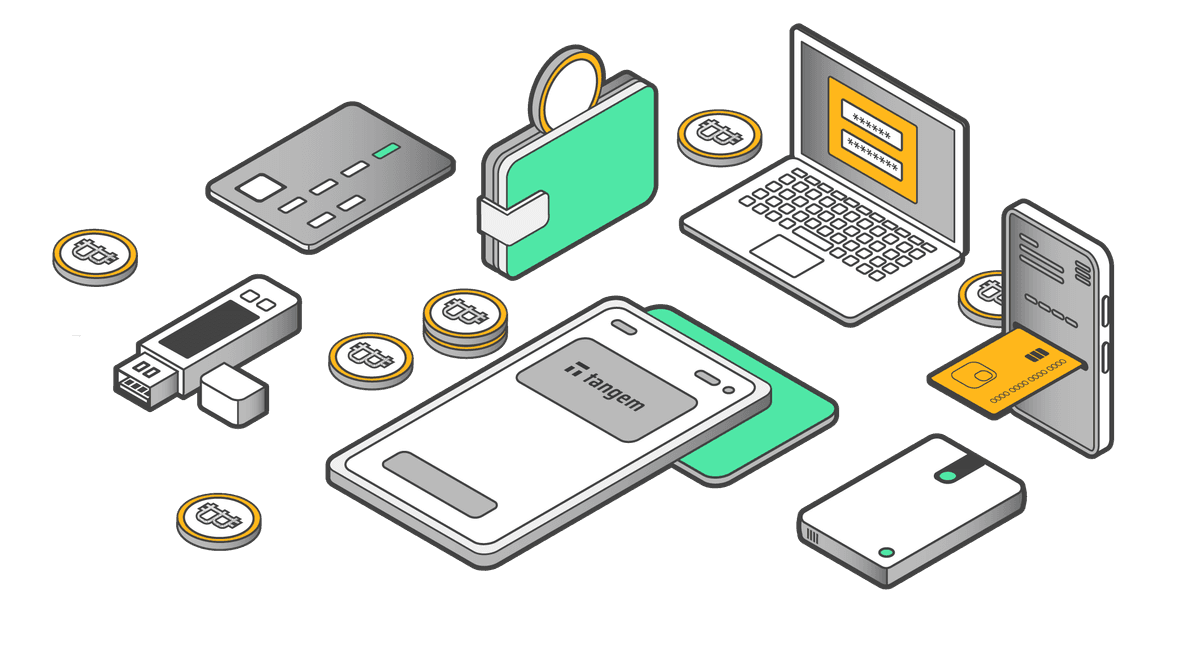
A wallet stores the keys that prove you own your cryptocurrency. Without a wallet, you can't hold, send, or receive crypto.
When you create an account on Binance, you automatically get a wallet. Binance manages it for you—no extra setup needed. That's why we'll use it in this guide: it's the largest exchange with the lowest fees, and it gives you both a platform and wallet in one place. That said, like all centralized exchanges, Binance operates under government regulations and has restricted accounts in some regions for political or compliance reasons. For getting started, it works well. For long-term holdings, consider self-custody (covered in our advanced guide).
Getting Started with Binance
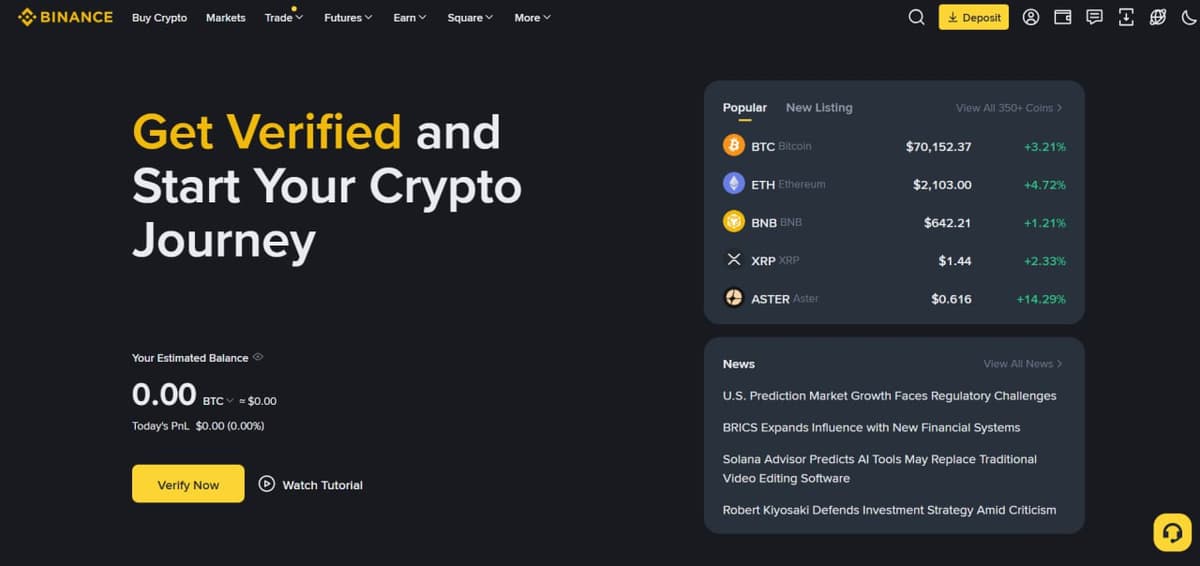
Go to binance.com and click "Register." You'll be taken to the sign-up page where you can create an account using your email, phone number, or sign in with Google, Apple, or Telegram.
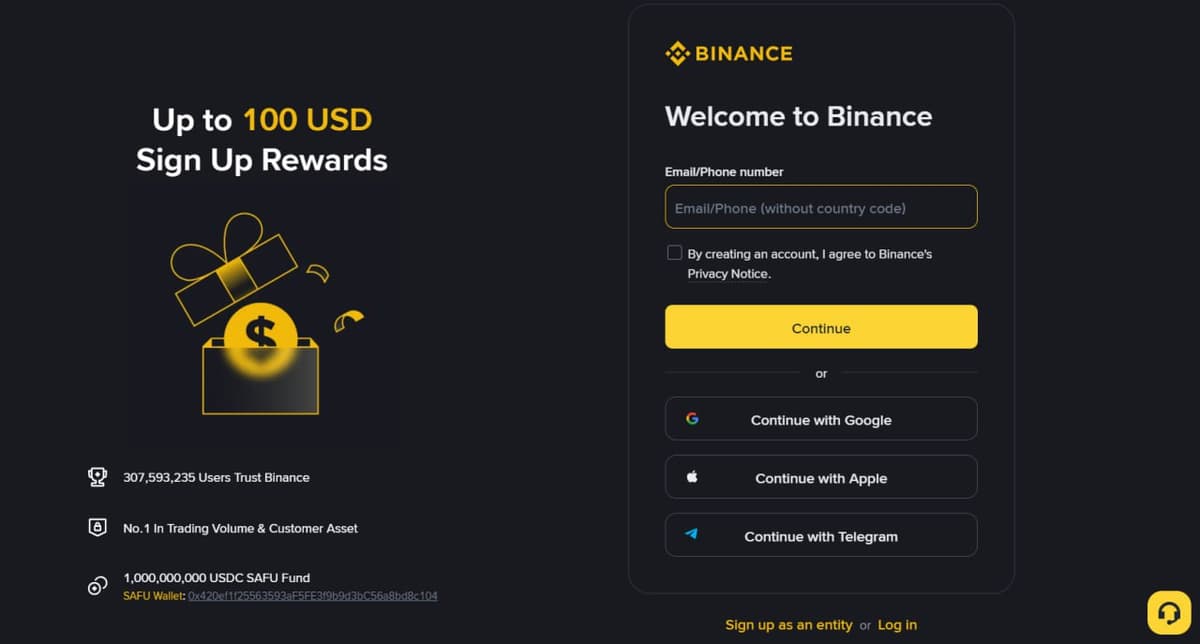
You'll need to provide your email, create a strong password, and complete identity verification (KYC)—uploading a photo of your ID and sometimes a selfie. This is required by law in most countries.
Why KYC is required: Regulations require exchanges to verify customer identities to prevent money laundering and fraud. While this might seem inconvenient, it also means the exchange is operating legally and is more trustworthy.
Once registered, you can log in to your account at any time.
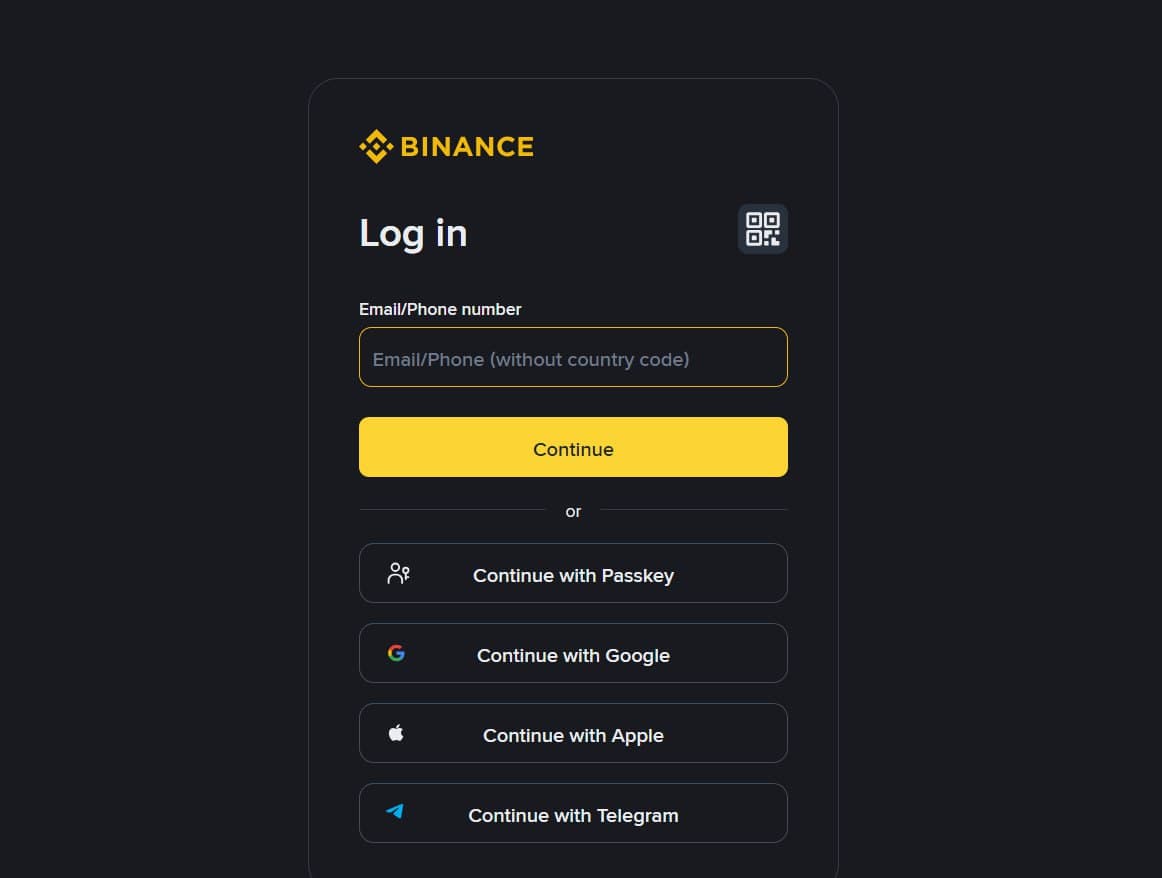
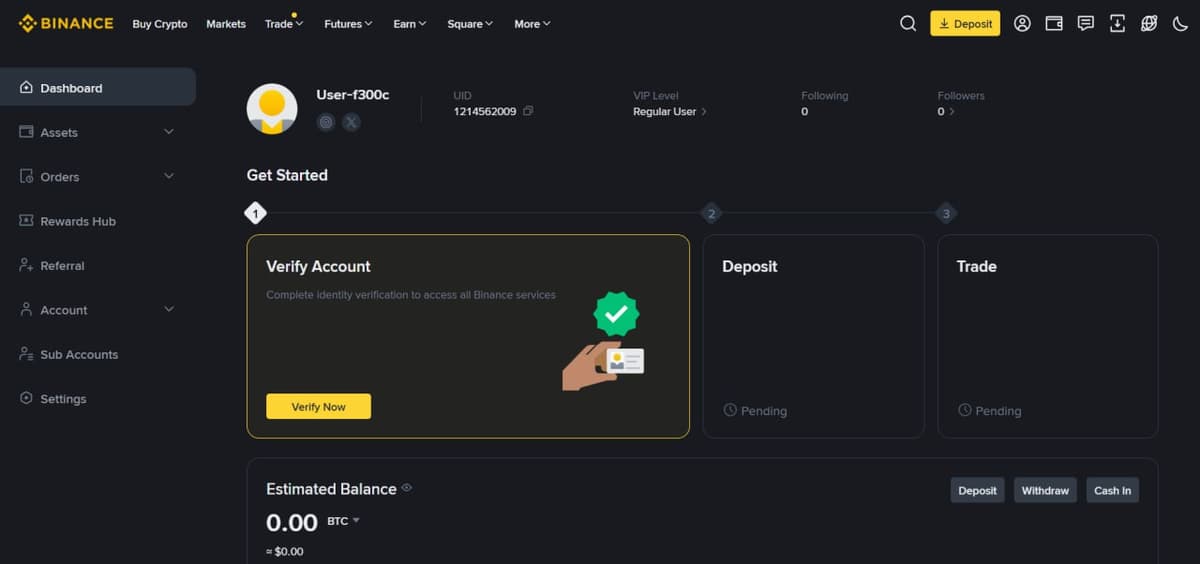
After logging in, you'll see your dashboard with a clear "Get Started" guide that walks you through three steps: verifying your account, making your first deposit, and starting to trade.
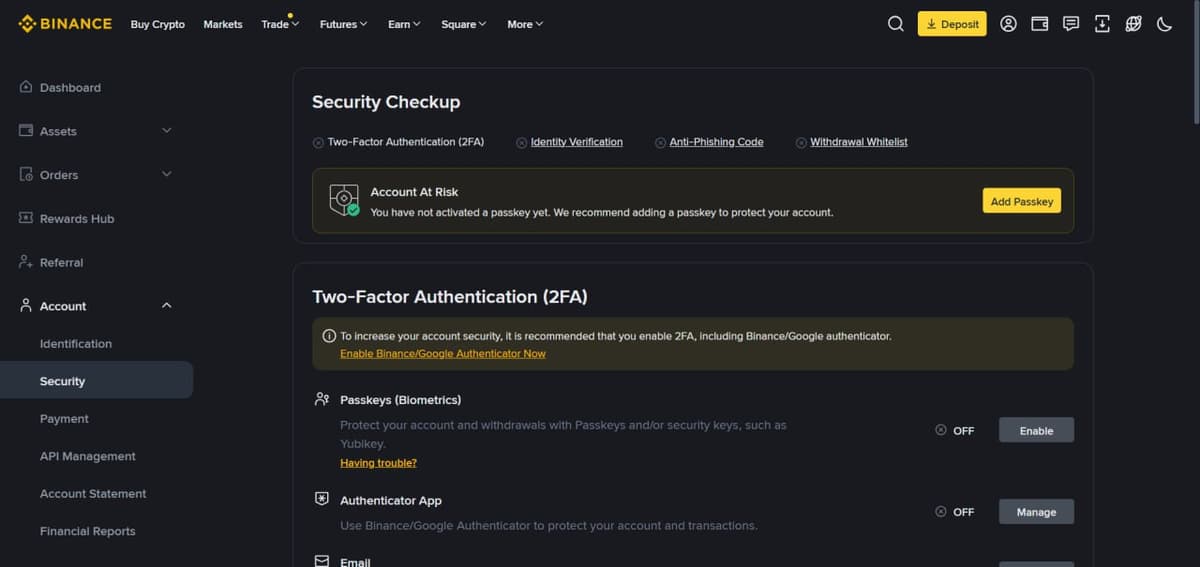
Before making any purchases, go to your account security settings and enable 2FA (two-factor authentication). This adds an extra layer of protection to your account.
Making Your First Purchase
Once your account is verified, navigate to "Buy Crypto" from the top menu. Select "Credit/Debit Card" as your payment method. Choose how much you want to spend in your local currency (USD, EUR, etc.) and select which cryptocurrency you want to buy—Bitcoin (BTC) and Ethereum (ETH) are good starting points for beginners.
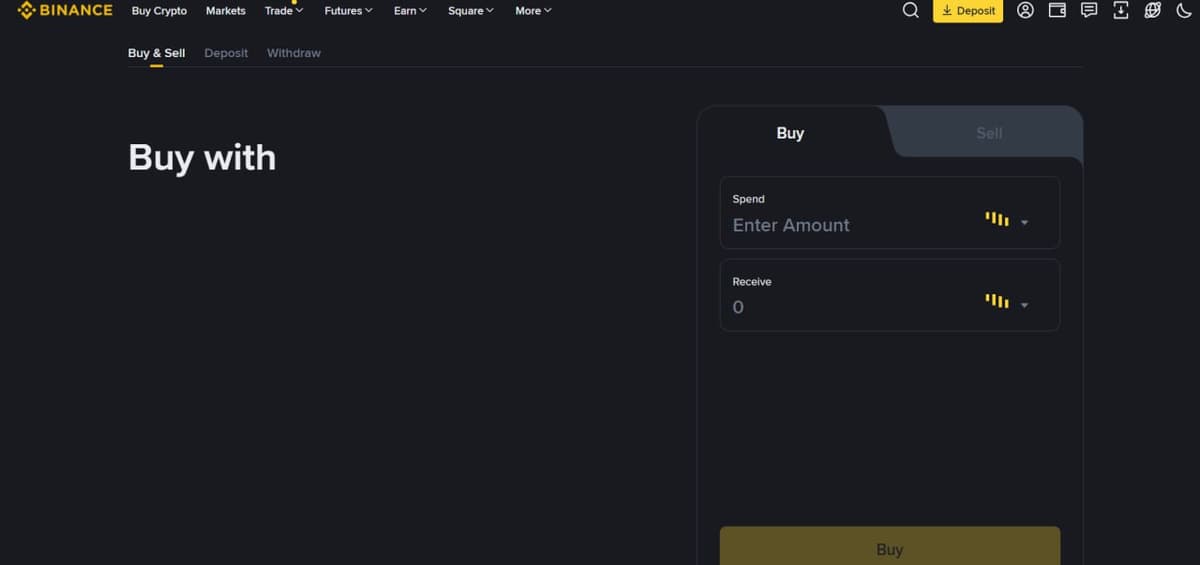
Enter your card details and confirm the purchase. The crypto will appear in your Binance wallet within seconds. You can view all your holdings in the Assets section.
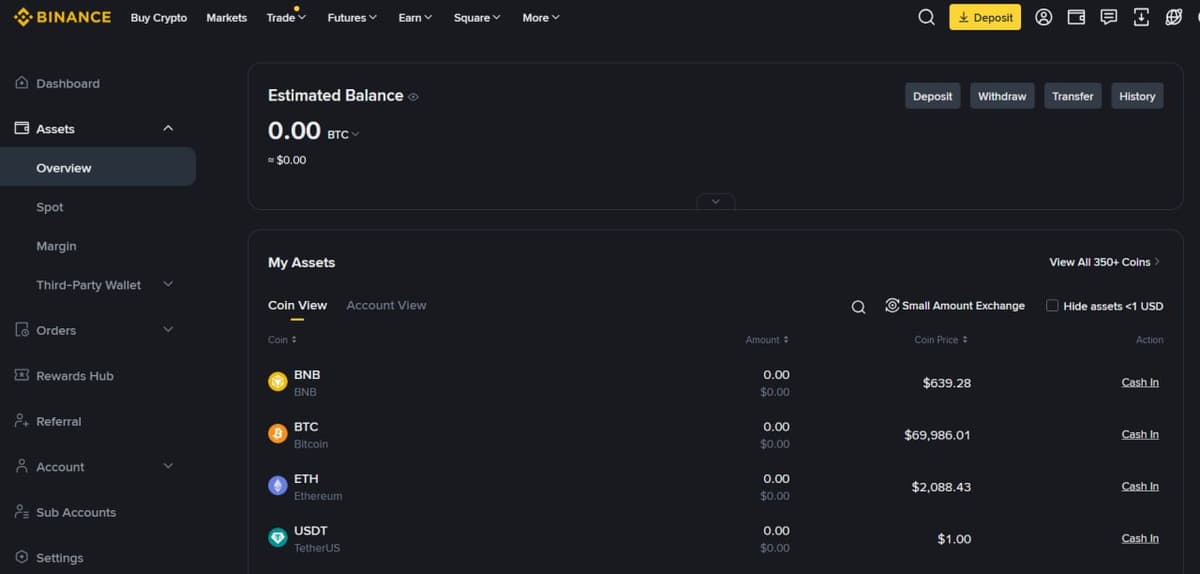
From there, you can hold it on Binance, trade it for other cryptocurrencies, or send it to someone else.
Converting Between Cryptocurrencies
If you want to swap one cryptocurrency for another (for example, converting USDT to BTC), you can use the Convert feature for instant trades at current market prices.
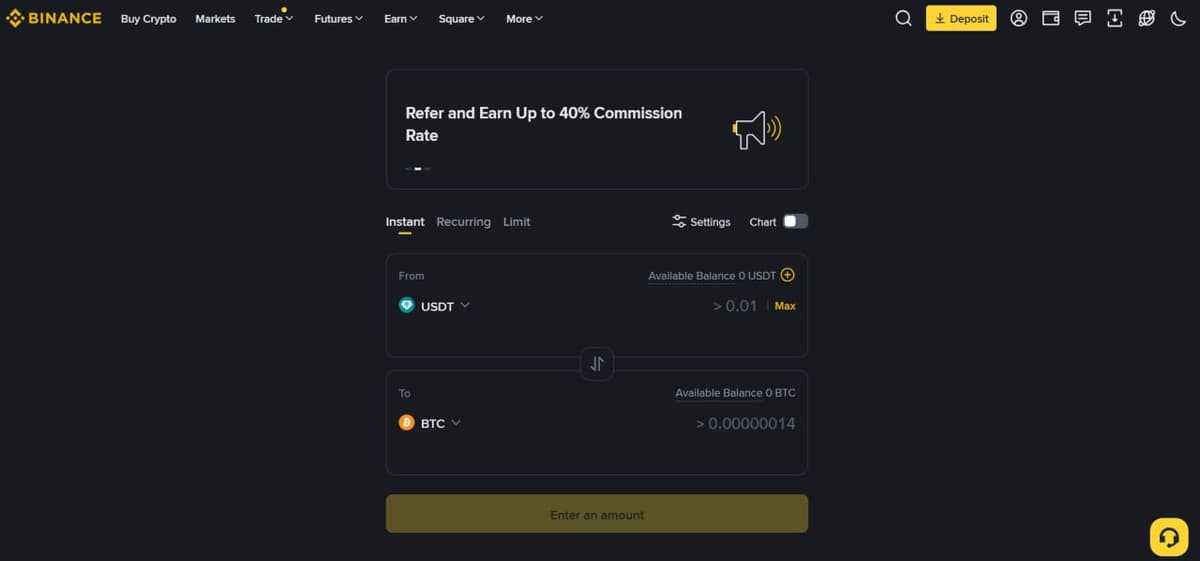
For more advanced trading with charts, order books, and detailed market data, Binance offers a full trading interface.
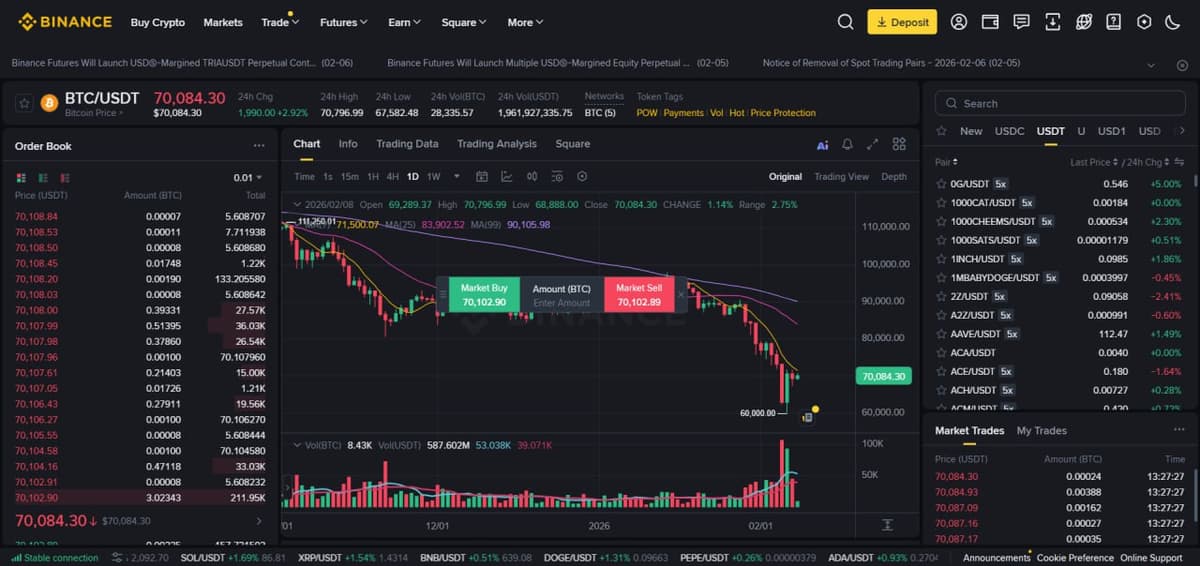
Earning Passive Income
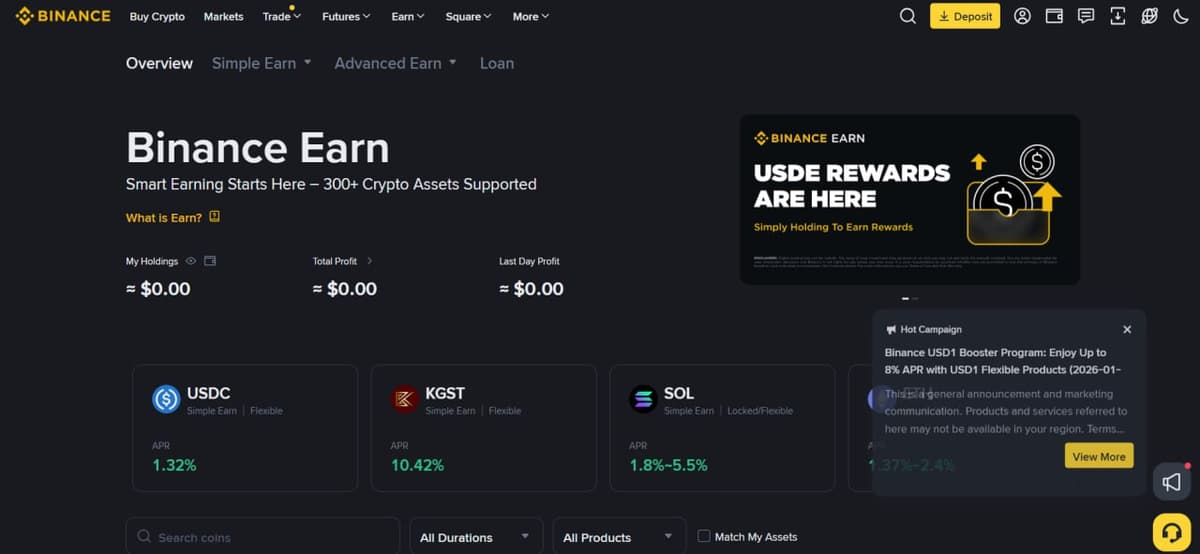
Binance also offers an "Earn" feature where you can stake your crypto assets to earn interest over time—similar to a savings account but for cryptocurrency.
Here's what you can expect in fees:
| Exchange | Card Fee | Processing Time |
|---|---|---|
| Binance | ~2% | Instant |
| Coinbase | ~4% | Instant |
| Kraken | ~4% | Instant |
| Bitstamp | ~5% | Instant |
Fees are approximate and change frequently. Check each exchange's fee page for current rates.
Binance generally offers lower card fees than competitors. You can also deposit via bank transfer for even lower fees (often free), though it takes a few days to process.
Tip: Some banks block crypto purchases. If your card is declined, try a different card or use a bank transfer instead.
Starting Small: Consider starting with a small amount (like $20-50) for your first purchase. This lets you learn the process without significant risk.
How to Send Cryptocurrency
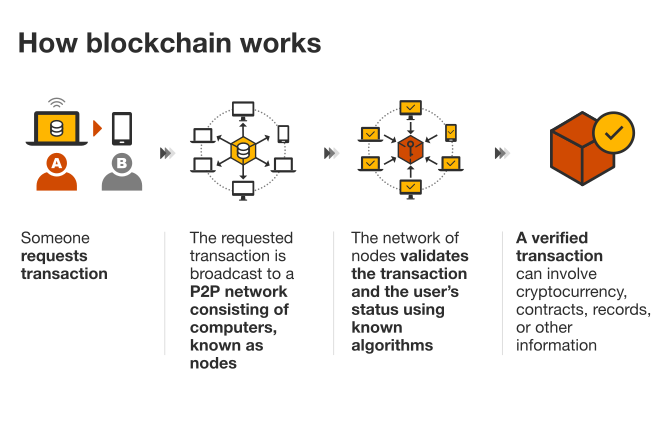
Whether you're sending money to family abroad, paying a friend, or moving funds between wallets—here's what you need to know. Every crypto transfer requires exactly three pieces of information:
- The currency - Which cryptocurrency you want to send (e.g., Bitcoin, Ethereum, USDT)
- The network - Which blockchain network to use (e.g., Bitcoin network, Ethereum network, Solana network)
- The wallet address - The recipient's unique address on that network (usually a long string like
0x742d35Cc6634C0532925a3b844Bc9e7595f0bEb)
Critical warning: The network must match! Sending Bitcoin on the wrong network or to an incompatible address can result in permanent loss of funds. Always double-check that the currency, network, and address are all compatible before confirming the transaction.
Best practices when sending crypto:
- Always send a small test transaction first (like $5) to verify everything works
- Double-check the recipient's address character by character (or use QR codes)
- Confirm the network with the recipient before sending
- Be aware of transaction fees—they vary by network and time of day
- Blockchain transactions are irreversible—there's no "undo" button
Example scenario: Your friend wants you to send them $100 in USDT. They give you their address and tell you to use the "Solana network." You would:
- Open your wallet or exchange
- Select USDT as the currency
- Select Solana as the network (not Ethereum, not Tron)
- Enter their wallet address
- Send a small test amount first ($1-2)
- Once confirmed, send the remaining amount
Staying Safe
A few simple habits will protect you from most problems:
- Enable 2FA on your Binance account (use an authenticator app, not SMS)
- Use strong, unique passwords for each platform
- Bookmark the real sites (scammers create fake lookalike websites)
- Start with small amounts while you're learning
- Test with small transactions first before sending larger amounts
- If someone contacts you first offering crypto help or investment advice—it's a scam
Red flag: No legitimate platform will ever ask for your password. If anyone contacts you asking for login details or "recovery phrases," they're trying to steal from you.
Final Thoughts
You now understand how cryptocurrency works: the technology (blockchain), the currencies (Bitcoin, Ethereum, stablecoins), the networks they run on, and the platforms and wallets you use to buy, store, and send them.
For everyday use—sending money to family, making purchases, or holding some crypto—Binance gives you everything you need in one place. Create an account, enable 2FA, and you're ready to go.
The most important things to remember:
- Double-check networks and addresses before sending—transactions can't be reversed
- Start small until you're comfortable with the process
- Never share your passwords with anyone
Cryptocurrency removes the middlemen between you and your money. Take your time learning, and you'll find it simpler than it first appears.
Ready for more control? Once you're comfortable with the basics, you might want to explore self-custody wallets—where you hold your own keys and no company can access your funds. Read our guide: Taking Control: Self-Custody Wallets and Advanced Security
Note on regulations: Cryptocurrency is regulated differently in each country. Most require exchanges to verify your identity (KYC), and you may owe taxes on any profits. Check your local laws.
References
Links mentioned in this guide:
- Binance – Exchange platform used in this guide
- Taking Control: Self-Custody Wallets and Advanced Security – Our advanced guide for self-custody
Further Reading & Useful Links
Learning Resources
- Binance Academy – Free courses and articles on crypto basics
- Coinbase Learn – Beginner-friendly crypto education
- Investopedia Cryptocurrency – In-depth articles and definitions
- Ledger Academy – Security-focused educational content
Official Documentation
- Bitcoin.org – Original Bitcoin documentation and resources
- Ethereum.org – Ethereum foundation's official resources
Market Data & Analytics
- CoinGecko – Cryptocurrency prices, charts, and market data
- CoinMarketCap – Market capitalization rankings and data
- DeFi Llama – Decentralized finance analytics
Regulatory Resources
- European Crypto Initiative – EU cryptocurrency regulations
- FATF Virtual Assets – International AML guidelines for crypto